
Scripture and the study margin
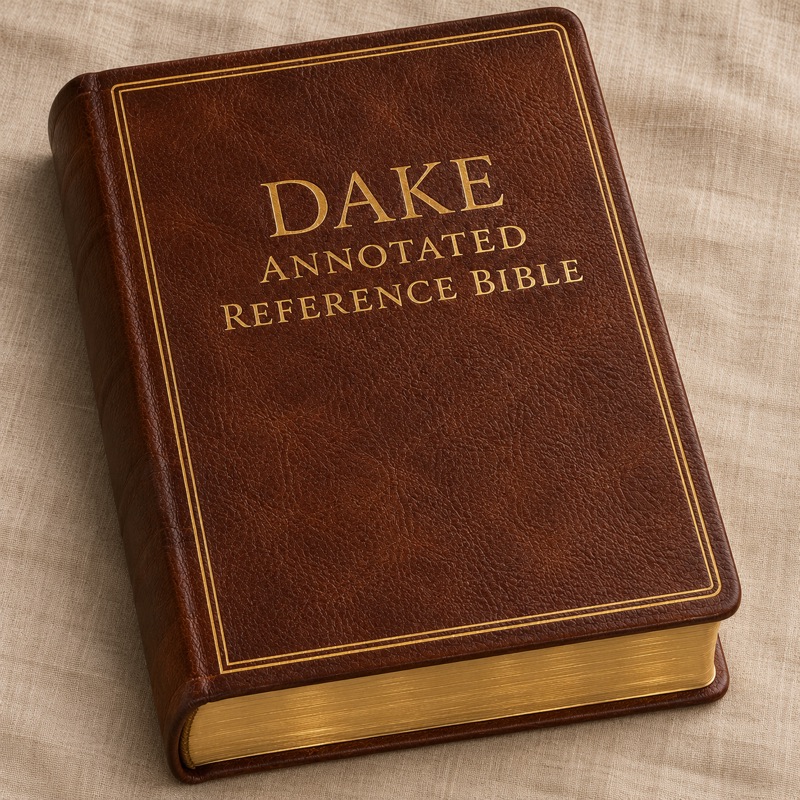
The Dake Annotated Reference Bible
Finis Jennings Dake set out to put a reference library in the hands of an everyday Bible reader. His annotations sit alongside the King James text so you can examine a word, compare passages, and follow a book’s argument for yourself.
What’s inside
A guide alongside the text
- Study notesSee how Dake explains a phrase and why he reads it that way.
- Cross-referencesFollow a promise or theme from one book of the Bible to another.
- Word studiesLook behind an English word to the Hebrew or Greek term.
Outline headings offer a wider view: when you have finished studying a verse, step back and see how it fits into the chapter.
See the notes at work in a sample study ↓An open study · No sign-in needed
Why “the true vine”?
Start with Jesus’ words. Then follow one of the small letters that Dake placed beside the text.
The Gospel according to John · 15:1
“I am the true vine, and my Father is the husbandman.”
King James Version
Dake’s note on “true vine”
Dake points to Isaiah 5:1–7. In Isaiah’s song, Israel is the vineyard: its owner plants a choice vine, but it yields wild grapes. Dake contrasts that outcome with Christ, the true vine who brings forth good fruit.
John 15:1, note g · Summarized from Dake’s annotationFollow the reference: Isaiah 5:2, 7
“... and he looked that it should bring forth grapes, and it brought forth wild grapes.” Isaiah 5:2, KJV (excerpt)
“For the vineyard of the LORD of hosts is the house of Israel ...” Isaiah 5:7, KJV (excerpt)
Verse 2 describes the disappointing harvest. Verse 7 names the vineyard and explains what the owner looked for: judgment and righteousness.
Look closer at a word: “abide” in John 15:4
“Abide in me, and I in you.” John 15:4, KJV (excerpt)
Dake gives meno as the Greek word and explains it in terms of remaining, continuing, or dwelling. He reads the verse as a command to remain in Christ: a branch cannot bear fruit on its own.
John 15:4, note k · Summarized from Dake’s annotationBehind the annotations
A reference library in the margins
In his testimony, Dake described his recall of Scripture as a gift from God. In the introduction to his Bible, he estimated that he spent 100,000 hours studying over 43 years. The New Testament edition appeared in 1961; the complete Bible followed in 1963.
His aim was practical: someone without a shelf of commentaries, dictionaries, and concordances could still investigate a passage. In John 15 alone, you can use a cross-reference to look back to Isaiah, a word study to slow down over “abide,” or the outline headings to trace the argument from the vine to the branches.
Hear Dake tell his story →Your Dake library
Read the digital Bible
The digital edition includes all 66 books, Dake’s annotations, and 25 chart pages. Read online or download a personalized EPUB. One-time purchase: $44.95.
If you already have access, sign in and return to this page. Choose Read my Bible to open your reader.
My Dake account →Looking for a physical copy? Print edition information at Revival.